Long-Tail Keyword Strategy for New Blogs: How We Went From Position 54 to Having a Plan That Actually Works
Quick Answer:
A long-tail keyword strategy means targeting specific 4–7 word phrases with low keyword difficulty instead of competing for broad terms. For a new blog with no domain authority, this is the only realistic path to page-one rankings in 2026. Pick phrases Google has not handed to HubSpot or Ahrefs, build content clusters around them, and open every H2 section with a direct answer. That structure wins both traditional rankings and AI Overview citations.
Who this is for:
Marketers, bloggers, and content leads who launched a new site in the last 12 months, published articles that are barely ranking, and want a keyword strategy that works without backlinks or domain authority.
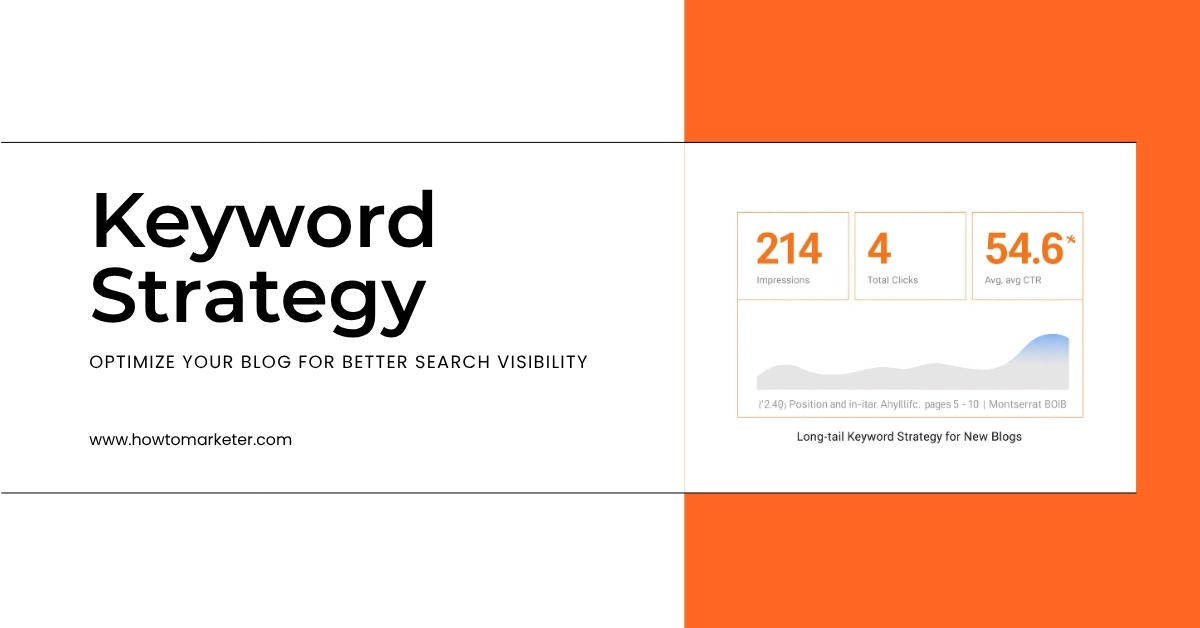
Six months. 214 impressions. 4 clicks. Here is what that actually looks like:
I opened Google Search Console last week and stared at a number I had been avoiding: 4. Four clicks. In six months. On a marketing blog about marketing.
The impressions were not zero — 214 of them, spread across queries like "social seo," "micro communities," and "smart keyword loading." Google had indexed the site. It knew the content existed. It just placed every single article between positions 55 and 96. Pages six to ten. The digital equivalent of a filing cabinet nobody opens.
The content had been written using AI. Structured, grammatically correct, covering the right topics. But it read like every other article on those topics — assembled from the internet, not drawn from real experience. No long-tail keyword strategy. No content clusters. No GEO structure. Just standalone articles sitting in the dark. Here is exactly what we found, what it meant, and what we changed.
Source: HowToMarketer.com Google Search Console, Dec 2025–Jun 2026
Why does Generic AI content park itself on page six and stay there
This is not a story about Google penalising AI content. The articles were not penalised — they were indexed, connected to relevant queries, and earning impressions. The problem was the position. And position is determined by how specifically your content matches what the searcher typed, combined with how much Google trusts your domain.
A new site with no backlinks has exactly one lever: keyword specificity. You cannot outrank HubSpot on "content marketing strategy." Those terms belong to sites with decade-long authority signals. What you can do is find the four, five, six-word phrases nobody has built a dedicated page around — phrases where the top results are Reddit threads, personal blogs, and Medium posts from 2019. That is your window.
The content we published targeted phrases that were either too broad or too vague to win. Average position 54.6 is the exact outcome you should expect from that approach. It is not failure — it is baseline. Here is how to move off it.
| Element | Old approach — what failed | New approach — what we switched to |
|---|---|---|
| Keyword length | Short 1–3 word phrases | 4–7 word specific phrases |
| KD target | Not checked | Under 30 only |
| Content tool | Gemini, generic output | Claude + practitioner data |
| Article structure | No GEO structure | Question H2s, direct answers |
| Internal links | Standalone articles | Clustered, pillar + spokes |
| Schema | None planned | Article + FAQ schema |
| Backlink strategy | None | Medium companion, 2 weeks later |
The shift: stop writing for topics and start writing for exact queries
The topic is "content marketing." A query is "a content calendar system that gets executed." The topic is "email marketing." A query is "why email open rates are misleading, what to track instead." The first version of each is what you think you should write about. The second version is what someone with a specific frustration types into Google at 9 pm when something is not working. Switching to a long-tail keyword strategy means you write the query, not the topic.
Every article targets one 4–7 word phrase with a keyword difficulty under 30. You Google the phrase before writing and check whether the top results are owned by major brands or by sites you could compete with. You build content in clusters — a pillar page surrounded by supporting articles, all linked together — so Google sees topical depth, not isolated pages. And every H2 header becomes a question with a direct one-sentence answer. That structure is what gets you cited in AI Overviews.
How to build a long-tail keyword strategy for a new blog
1. Find phrases Google has not already given away
Google the target phrase. If HubSpot, Ahrefs, Neil Patel, or Backlinko own the top 3 results — stop. Find a more specific angle. If Reddit threads, personal blogs, or Medium posts appear — proceed. That is your competition gap.
2. Build from People Also Ask — not keyword tools
Search your broad topic in Google. Expand every PAA question. These are exact phrases real users typed, with verified intent, usually sitting at keyword difficulties well under 20. The top 5 queries already in our Search Console — "social seo," "micro communities," "smart keyword loading" — are all 2–4 word phrases, too short to win. The PAA boxes around them contain the specific versions worth targeting.
3. Build one cluster at a time — not one article at a time
One pillar page covers the broad topic at depth — 2,500 to 3,500 words. Around it, five to eight supporting articles each target a specific long-tail phrase. Every supporting article links back to the pillar. The pillar links out to every supporting article. Sites with properly built content clusters see an average 40% increase in organic traffic compared to non-clustered content, according to Digital Applied's 2026 analysis of 332 URLs.
4. Structure every article so AI can extract it
Every H2 header should be a question. The first sentence under that H2 should answer the question directly and completely — not in paragraph three. AI Overview extraction looks for the clearest, most direct answer to the implied question, not the highest-ranking page. A page at position 4 with direct answers in every section will be cited over a page at position 1 that buries its insights in long paragraphs.
5. Plan the Medium companion before you publish
Every HowToMarketer article needs a companion piece on Medium.com (DA 95) published two weeks after the main article. Different angle, 600–900 words, with 2–3 natural dofollow links back to HowToMarketer using anchor text that matches the target keyword of the linked article. This is the only scalable link-building tactic available to a new site without a backlink budget.
OUR ACTUAL SEARCH CONSOLE DATA — TOP 5 QUERIES
| Query | Impressions | Avg. Position | Clicks |
|---|---|---|---|
| social seo | 26 | 95.2 | 0 |
| smart keyword loading | 24 | 64.0 | 0 |
| social media community management | 20 | 91.7 | 0 |
| micro communities | 7 | 88.9 | 0 |
| what is social seo | 6 | 90.5 | 0 |
Source: HowToMarketer.com Google Search Console, Dec 2025–Jun 2026. Every query sits between position 55–96. Google sees the site. Users do not.
Why this approach compounds where the old one stalls
Long-tail keyword strategy works on a new site because it matches your actual competitive position to the difficulty of the targets you are choosing. You are not trying to outrank a DA 90 site on a DA 2 budget. You are finding specific questions nobody has answered well and answering them better.
The compounding effect comes from the cluster structure. Each new article you add to a cluster strengthens every other article in that cluster. The pillar page gains internal link equity from the spokes. The spokes gain topical relevance from the pillar. Over time, Google begins to see the site as an authority on the cluster topic — and that authority lifts keyword difficulty ceilings you could not compete with before. You build topical authority from the bottom up, which is the only realistic path for a site that launched without an existing audience or backlink profile.
Real talk: what six months of position 54 actually taught us
The honest version of this story is that the first six months were not wasted — they were data. 214 impressions told us Google had indexed the site and connected it to the right topics. Average position 54.6 told us the content was not wrong; it was just generic. The top queries told us exactly which topic areas Google already associated us with.
What we would do differently: connect Search Console on day one and read it weekly. Run the keyword filter before writing anything. Build the pillar page first, before a single cluster article. And use real practitioner experience as the core of every article — a specific number, a named tool, something that actually happened. Position 54 is where generic content without a human fingerprint ends up. That is the number we are now built to beat.
The wrap: what you have now that you did not have before
You now have the exact process a new marketing blog with zero domain authority uses to find winnable keywords, build content clusters, and structure articles for both traditional rankings and AI Overview citations. The approach does not require a backlink budget, a DA above 10, or a team. It requires specificity — phrases long enough that the big players ignored them, structured content direct enough that Google can extract it, and clusters tight enough that each article strengthens the ones around it. The experiment is live. The Search Console data is real. Come back in 90 days for the update.
Want to follow this experiment in real time?
We publish the Search Console updates, the ranking wins, and the failures every week. Join the HowToMarketer email list — practical guides only, no fluff.
→ Subscribe at HowToMarketer.com
Need Help Executing Your SEO Content Strategy?
A BitBop SEO Specialist handles keyword research, content cluster planning, on-page structure, and GEO optimisation — so you stop guessing and start ranking.
→ Visit BitBop.coABOUT THE AUTHOR
Written by the HowToMarketer team — practitioner marketers documenting what is actually working on a new site built in public. Every article is based on real data from the HowToMarketer.com Search Console. No theory, no speculation.
Frequently Asked Questions
What is a long-tail keyword strategy for a new blog?
A long-tail keyword strategy for a new blog means targeting specific 4–7 word search phrases with a keyword difficulty under 30 instead of competing for broad, high-competition terms. New sites with no domain authority cannot outrank established players on short keywords. Targeting specific queries where the top results are personal blogs, Reddit threads, or Medium posts gives a new site a realistic path to page-one rankings within 90 days.
How long does it take a new blog to rank for long-tail keywords?
A new blog targeting long-tail keywords with keyword difficulty under 30 can typically see first-page rankings within 8–12 weeks of publishing a well-structured article. Reaching the top 3 positions usually takes 3–6 months. Adding internal links between cluster articles and a Medium companion piece published 2 weeks after the main article can accelerate this timeline by building external authority signals without a link-building budget.
How do I find long-tail keywords with low difficulty?
The fastest method is People Also Ask boxes in Google. Search your broad topic, expand every PAA question, and note the 4–7 word phrases. These are verified search queries with clear intent, usually sitting at keyword difficulties well below 20. Cross-check each phrase in the Ahrefs or Semrush free tier to confirm KD is under 30, then Google the phrase itself to confirm the top results are not dominated by HubSpot, Ahrefs, or Neil Patel.
What is a content cluster and why does it matter for a new site?
A content cluster is one pillar page covering a broad topic linked to 5–8 supporting articles each targeting a specific long-tail phrase within the same topic. Every supporting article links back to the pillar. Sites with properly built content clusters see an average 40% increase in organic traffic compared to non-clustered content. For a new site, clusters signal topical authority to Google — the fastest way to build trust without backlinks.
Why does my new blog have impressions in Search Console but no clicks?
Impressions with no clicks almost always mean your content is ranking between position 11 and 100 — visible to Google but invisible to users. This is the exact outcome of targeting phrases that are either too broad, too competitive, or too vague. The fix: switch to longer, more specific keyword phrases with lower difficulty, restructure articles so every H2 opens with a direct answer, and build internal links between related articles.
How do you get cited in AI Overviews on a new site?
AI Overview citation is determined by content structure, not domain authority. Make every H2 header a question, open every section with a direct one-sentence answer, include at least one statistic per section, and implement FAQPage JSON-LD schema. These structural signals are what AI systems extract — no high DA score required.