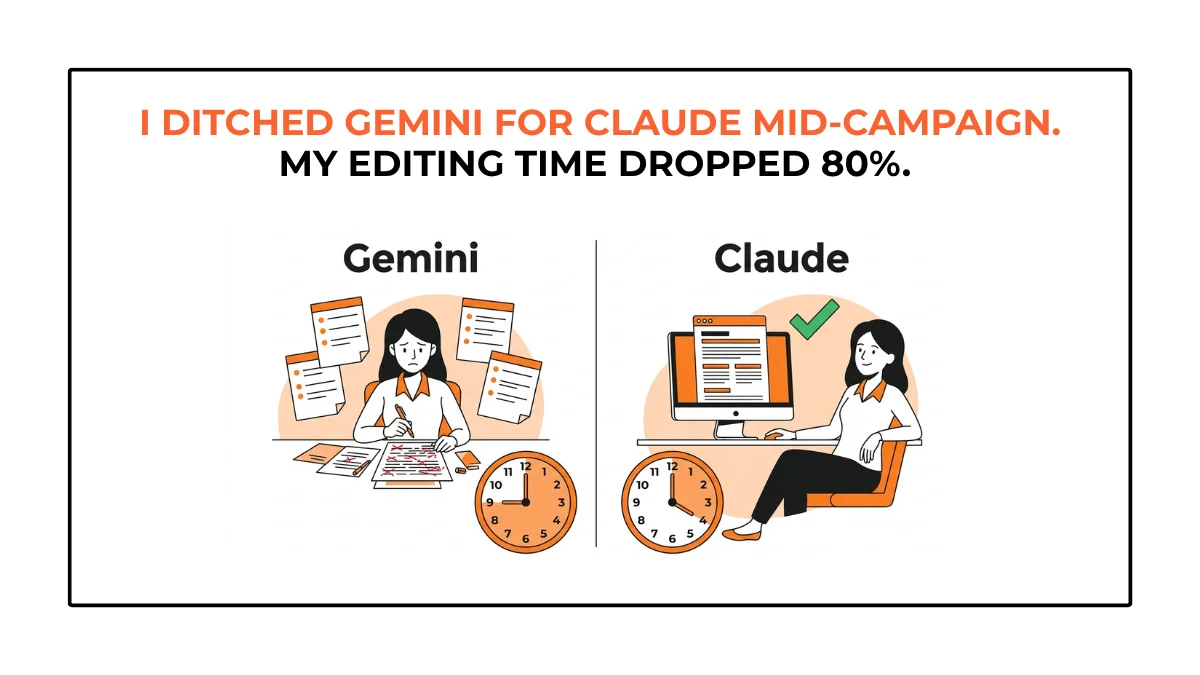
I Ditched Gemini for Claude Mid-Campaign. My Editing Time Dropped 80%. Here's the Honest Truth.
Who this is for: You use AI to write marketing content — blogs, emails, social posts, SEO guides. You have tried Gemini or are using it right now. And you are still spending way too long editing before anything sounds human enough to publish.
I used Gemini for six months.
It worked. Mostly.
Fast research. Clean outlines. It covered the brief without missing anything obvious. On paper, it saved time.
In reality, I was still rewriting every intro. Still re-explaining my tone halfway through because by section three, the output had drifted into something generic. Still spending ninety minutes editing a post that should have taken twenty.
My traffic was flat. My emails felt like they came from a polite stranger. And one afternoon, after a particularly painful editing session, I switched to Claude.
No plan. No test. Just a frustrated marketer trying a different tool.
The first draft landed differently.
It followed the brief. It held the tone I asked for, all the way through. And the intro — for the first time in six months — did not need to be rewritten.
The Real Before and After
Client revision data from independent content writing research, December 2025.
1. Why Gemini Produces Data Instead of Content
Gemini is Google's product. Google's entire business is finding and surfacing information. That DNA runs through everything Gemini writes.
Ask it for a blog post, and you get accurate, well-organised information. Current facts. Logical structure. All the right points covered.
What you do not get is interpretation.
One content marketer tested both tools on the same article. Gemini found eight relevant statistics and listed them — like a research assistant handing over notes. Claude took three statistics, provided manually, and wove them into a narrative about what those numbers actually mean for the reader.
Same task. Completely different result.
Facts without interpretation are raw material. With Gemini, turning that raw material into something worth reading is still your job — every single time.
2. What Claude Does Differently for Marketing Content
Four things changed when I switched. Not opinions. Actual differences in the work.
It holds the brief without forgetting it. Give Claude a clear structure, and it follows that structure across the entire post. Gemini drifts. By section three, it often loses the original angle and defaults to something safe and forgettable.
The tone stays where you set it. Claude writes with voice. It varies sentence rhythm, holds tone, and avoids filler phrases that make AI content feel robotic. Gemini reads like a well-organised briefing — strong on facts, weak on personality. For marketing content, voice is not optional. It is the product.
The intros are not copy-paste. Gemini opens the same way every time. Topic, why it matters, what we will cover. Claude opens the problem — the sentence that makes a reader stop scrolling and stay.
Long-form content stays coherent. For posts over 1,000 words, Claude maintains a clear narrative arc all the way through. Gemini produces solid sections that do not always feel like they belong to the same article.
3. Where Gemini Still Has the Edge
This post would not be honest without this section.
Gemini has real-time web access built in. For trend pieces or posts that need current statistics, it saves 15 to 20 minutes per article on research alone. That is a real advantage that Claude cannot match without you feeding it the data manually.
Gemini also integrates natively with Google Workspace. If your team lives in Google Docs and Sheets, that connection genuinely saves steps every day.
The smartest move is not picking one and abandoning the other. It is knowing where each tool actually wins.
4. The 3-Step Workflow I Now Run for Every Piece
Step 1 — Brief it like you are talking to a human editor. Do not hand Claude a topic. Give it to the reader, the tone, the structure, and one specific angle. For example: "Write for an in-house marketer frustrated that their blog gets traffic but no leads. Conversational tone, no jargon. Open with the problem. Three fixes. One tool recommendation. End with a next step." That brief takes sixty seconds to write. It saves ninety minutes of editing.
Step 2 — Add the 20% only you can add. Claude gets you to a strong, structured, on-tone draft. Your job is to drop in one real number, one result from a real campaign, one observation that nobody else has. That 20% is what makes the content uncopyable. It is also what makes it rank.
Step 3 — Publish without the anxiety. Posts that used to take three hours now take forty-five minutes. The editing is light. The tone is right. It reads as a person wrote it — because a person did, using better tools.
Want This Built Into Your Full Content System?
Switching tools is the easy part. Building a repeatable AI content workflow that produces publish-ready posts, email sequences, and social content consistently — that takes strategy and setup time most marketing teams simply do not have.
The team at BitBop builds AI-powered content workflows for marketers and founders from scratch. If you want content that sounds human, earns rankings, and converts readers into leads — without spending three hours on every post — BitBop can build that system for you.
Frequently Asked Questions
Is Claude better than Gemini for content marketing?
For writing — yes. Claude wins on long-form content, email sequences, and structured briefs. Gemini wins on real-time research and Google Workspace integration. For most marketers producing regular content, Claude handles the daily writing load better.
Can I use both together?
That is exactly what smart content teams do. Gemini for research and live data. Claude for writing and tone. Each tool on the stage actually wins.
What does Claude cost?
Claude Pro is $20 a month. Nearly identical to Gemini Advanced at $19.99. At the same price point, the choice comes entirely to what you are producing. For content marketing, the output difference is significant.
Does Claude follow a detailed marketing brief?
Consistently. It holds structure and tone across long posts and typically needs one explanation instead of three.
Tips
- Give Claude a reader, a tone, a structure, and a specific angle — not just a topic. Specifically produces specific output.
- Add one real number or personal result before publishing. That single addition makes the post yours and nobody else's.
- Use Gemini first when your post needs recent statistics. Then feed those facts into Claude to write the content around them.
- Read your first three sentences out loud. If they sound like how you would say it to another marketer, the tone is right.
Warnings
- Do not publish Claude output without adding your own experience or data. Content without a human layer is detectable and forgettable.
- Do not ask Claude to find current events without feeding the data yourself. Always provide fresh statistics for trend-driven posts.
- Do not treat the first draft as final. A vague brief produces a vague post. Tighten the prompt before touching the output.
Things You Will Need
- A Claude account at claude.ai — free tier available, Pro at $20 a month recommended for a full content workflow.
- A brief template you use consistently for every post — the same input structure produces predictable quality output.
- One real data point, result, or personal observation ready to add to every piece before hitting publish.
- Your CMS login — because with this workflow, you will actually be ready to use it.